
What is NADA?
A protocol built for the hardest moments.And quietly brilliant for the ordinary ones too.
The NADA protocol was developed in the 1970s at Lincoln Recovery Center in the South Bronx: a community-led response to the addiction crisis devastating the neighbourhood.
Psychiatrist Dr. Michael Smith, building on research into auricular acupuncture (pioneered by Dr. H L Wen), helped develop a standardised five-point protocol that could be delivered simply, safely and at scale.
That simplicity is not a limitation.It’s the whole point.That simplicity is not alimitation. It’s the whole point.
Where it came from
It worked. And then it spread.
Since its development in the 1970s, NADA has been used in hospitals, addiction recovery centres, trauma programmes, psychiatric care, disaster response and community health settings across many countries.
It requires no equipment beyond needles and a chair. It needs no shared language. It asks nothing of the person receiving it except that they sit quietly and receive.
- Developed in the 1970s at Lincoln Recovery Center in the South Bronx as a community-led response to addiction and withdrawal support.
- Used in addiction recovery, mental health, trauma response and community wellbeing in over 40 countries around the world.
- Since 1991, NADA has been used in the UK across addiction and mental health, including the NHS and the prison system.
A deeper understanding
How NADA works
The ear is sometimes described as the body’s switchboard. Stimulating specific points on the outer ear sends signals to your internal systems without being invasive, a similar principle to reflexology.
NADA works along the body’s meridian system: energy pathways that have been mapped and used in acupuncture medicine for centuries. The five points used in the protocol each correspond to a specific organ system.
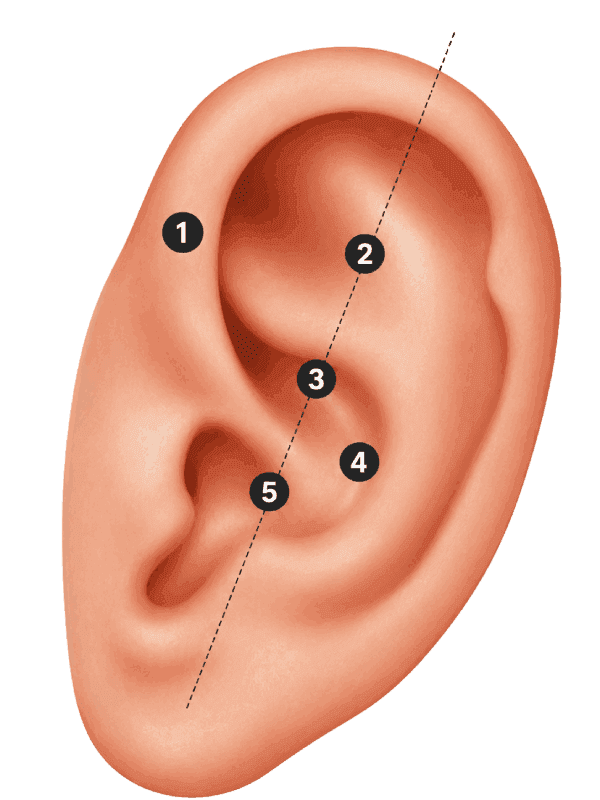
- Sympatheticregulates the nervous system and helps the body move out of fight-or-flight.
- Shen Mencalms the mind, softens anxiety and helps release tension.
- Kidneysupports the body’s foundational energy and is traditionally associated with fear and fatigue.
- Liversupports detoxification and helps soften anger or reactivity.
- Lungsupports breath, grief, emotional release and processing.
Together, these five points support the body’s natural detoxification processes and help shift the nervous system from fight-or-flight into rest-and-digest: the restorative state most of us rarely access, and which the body needs in order to recover.
Research suggests the mechanism may involve the release of neurotransmitters including dopamine, GABA, serotonin and endorphins: the body’s own chemistry doing the work, prompted by the needles.
Not drowsiness. Not numbness. Just balance.
Questions before you book
Frequently Asked Questions
Honestly, most people feel very little. The needles used in auricular acupuncture are extremely fine, far finer than anything you’d encounter at a GP or nurse appointment. You may notice a brief warmth or a very light sensation on insertion, which typically settles within moments.
Some people feel a gentle heat at one or more of the points as the body responds. This is normal and usually fleeting. If you do experience any discomfort after the first ten minutes or so, please let me know quietly during the session.
NADA stands for the National Acupuncture Detoxification Association. The protocol is a gentle, non-verbal form of auricular acupuncture using up to five tiny needles placed on specific points of the outer ear.
It was originally developed to support people managing withdrawal from alcohol, drugs and nicotine, and has since been widely adopted as a therapeutic tool across mental health, stress management and community wellbeing settings.
People often seek NADA alongside support for stress, overwhelm, poor sleep, grief, emotional regulation and other mental or physical imbalances.
- Stress, overwhelm and burnout
- Anxiety, low mood and depression
- Poor sleep and fatigue
- Grief support and emotional regulation
- Anger management
- PTSD
- Obsessive or impulsive thoughts and behaviours
- Headaches, tension and blood pressure issues
- Menopausal symptoms including night sweats, itchy skin and inflammatory pain
- Side effects of chemotherapy
Please note: NADA is a complementary therapy and is not a replacement for medication or medical advice. If you have any concerns, please consult your GP or clinician before attending, and always inform Cassie of any relevant health information prior to treatment.
The ear is sometimes referred to as the body’s switchboard. Stimulating specific points on the outer ear sends signals to your internal systems without being invasive, similar in principle to reflexology.
NADA works along the body’s meridian system, using five specific points: Sympathetic, Shen Men, Kidney, Liver and Lung. Together, they are traditionally used to support regulation, calm and the body’s natural restorative processes.
The result is often felt as a deep sense of calm, balance and physical renewal.
Before the treatment begins, the outer part of each ear is gently cleaned with a skin-safe sterilising spray and cotton wool. Nothing is ever inserted into the ear canal.
Up to five teeny-tiny, single-use, sterile needles are then placed on the specific points on each ear. You’ll sit or lie quietly and comfortably for 30-40 minutes, supported by gentle background music and a calm, carefully considered environment.
Cassie remains in the room throughout the session. After 30-40 minutes, she carefully removes all the points, cleans the ears once more, and collects every needle into a sharps disposal unit.
Important: If a point falls out during the session, please do not pick it up or reinsert it yourself. Cassie will safely collect it at the appropriate moment. Please remain seated until all points have been removed or collected.
Yes. The needles are single-use, sterile and disposable. Nothing is ever inserted into your ear canal.
There are very few contraindications for NADA. If you are pregnant, have a bleeding disorder, are on blood thinners, or have any concerns about a specific health condition, please speak to your GP before attending and inform me before your session.
If you are a blood donor, you will not be able to give blood until 4 months after your last NADA treatment.
That’s actually one of the most common things I hear before someone’s first session, followed almost immediately afterwards by: “that was nothing.” The needles used for auricular acupuncture are a completely different experience from anything clinical.
If you’d like to talk it through before booking, please do get in touch. I’m happy to chat.
No. Genuinely, no. The NADA protocol is designed to work quietly with your nervous system and your body’s own chemistry. Your beliefs don’t need to get involved.
Come curious, come sceptical, come exhausted. It doesn’t matter. Just come.
Even a single session can bring a noticeable sense of calm and restoration. The word most commonly used by people after their first treatment? Content.
Over time, as the effects accumulate, many people experience deeper, more sustained shifts: greater emotional regulation, improved sleep, reduced reactivity and an overall sense of balance and ease.
As NADA is often used as a detoxification treatment, it’s recommended that you stay well hydrated afterwards. Some people notice mild temporary release responses, such as needing the bathroom more than usual, feeling emotional, a little sweaty or slightly congested. Some people don’t experience this side of the process at all.
Yes. Like any meaningful lifestyle support, NADA works best with commitment and consistency. While the benefits may be felt from the first session, deeper and more lasting regulation tends to build over time.
Whether you come for a single de-stress session or you’re ready to commit to a longer-term practice, every session is doing something genuinely supportive for your wellbeing.
Sessions are held in small groups of no more than eight people. NADA is uniquely well-suited to a group setting because the shared quiet can help deepen the meditative state for everyone in the room.
This is not talking therapy. There is no pressure to share, no history to recount. There will be a brief settling-in moment at the start and a few grounding breaths at the end, but the session itself is held in silence.
Group sessions ask for a gentle level of mutual respect: quiet, stillness and a willingness to simply receive.
No. NADA is a complementary therapy. It works alongside other support, not instead of it. It is not a substitute for medical advice, medication, or professional mental health treatment.
If you have any doubts about whether NADA is suitable for you, please speak to your GP or clinician first.
After your treatment, you’ll have the opportunity to receive ear seeds. These are tiny 24-carat gold balls on medical-grade tape, placed on the same points to provide gentle, low-level stimulation between sessions.
Ear seeds can be left in place for 3-5 days. Cassie will demonstrate how to remove them safely before you leave.
Very little. Come as you are. Eat something light and stay hydrated beforehand. Wear comfortable clothing. Hair clips or bobbles are helpful for sessions involving NADA ear acupuncture.
Plan to stay comfortable and quiet for around 40 minutes. That’s the whole list. No prior experience, belief system or knowledge is required.